Saturday, February 27, 2010
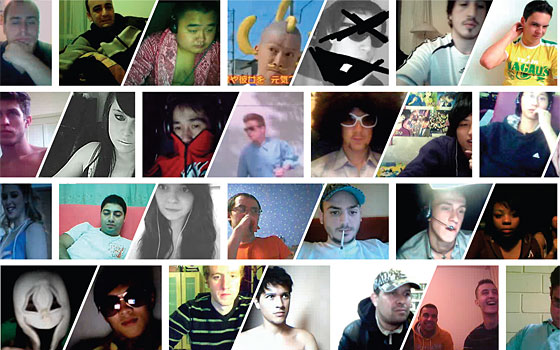
Chatroulette - The Party Game...and a strong case for more internet anonymity?
Chatroulette, the niche internet phenomenon that is sweeping the universe (or, at least certain areas in NYC), has become a re-occurring theme these past few weeks for me. It's been popping up in class, in my social circles, and most recently at a birthday party.
So, I am happy to report that I was witness to, and participated in, a grand social experiment last night. At a birthday party for a friend, I saw the community powers of Chatroulette on full display. Apparently, with a willing group of people that were all willing to forgo common decency and etiquette, Chatroulette becomes the party event of the year.
My wife and I were invited to a birthday party for a friend of ours, who happens to be gay. He was the one who originally introduced us to Chatroulette weeks before, and upon arriving at his party, we found about 6 of his friends (also gay) looking at Chatroulette on a large screen tv. One person would be on it at a time, egged on by the others. I mention "gay" not to categorize these individuals in a certain way, but to detail how their sexual orientation played off against some of the people we "met" online. It's not often that you get a control group that is 10-12 gay men, myself, and my wife!
Chatroulette was not a passive movie or tv show, but something that was live and interactive...each person would get about 10 minutes to use it, while we all watched, commented, and yelled out actions or commands. This being a party with already liberal-minded guests, it quickly devolved into how far you could push the Chatroulette strangers. It was immensely entertaining, as interesting social situations were played out right before me:
1. Straight high school or college boys who performed strange, homo-erotic acts towards us...showing their asses and slapping each other's chests, not assuming that the guys they were looking at were indeed gay and getting quite a kick out of it. Once they found out, well...it got awkward for them.
2. Younger girls who wanted to talk to the cute older guys (my friends at the party) until they realized they were gay. At that point, they became kind of amazed by it...or lost interest.
3. The fact that many people are willing to expose themselves sexually within the cloak of anonymity.
4. In the end, it's still a straight, heterosexual male world...and their usual defense mechanism is to call "gay" on anyone who might make them feel the least bit threatened. Ironic when actually confronted with gay individuals.
I'd like to mention point 3 again, because that is the most interesting for me. In an internet populated with Facebook, Twitter, and all sorts of googling of people and their information, there seems to have a new appeal of having anonymity. Chatroulette actually opens up our inhibitions again. For many of us, who realize that our personal lives and thoughts are posted all through social media networks, our inhibitions are being slowly wrapped up even more. As parents and grandparents enter these same worlds, we are shutting down and mellowing out. Chatroulette seems to have opened that door again...
Photo Courtesy of New York Magazine
Monday, February 22, 2010
Sunday, February 21, 2010
Ensuring your digital demise...with some help.
Death, at least physical death, has always been the great unknown. Where do we go? What will we feel? What will happen to us?
And while many of us have pondered these very questions, many of us have yet to ask ourselves another, equally valid question...what will happen to our digital selves when we die?
Well, the answer (or a possible answer) has been found in a fascinating article this weekend in the new WIRED magazine called "Lifesavers", written by Scott Brown. Brown brings up the question that should be on all of our minds...if something happened to us tomorrow, what would (or should) remain of our digital personas online and "in the cloud"? From items such as bank account passwords and facebook identities, to videogame avatars and maybe even fake online personas, this information may live on long after our physical bodies have gone to rest.
In his article, Brown has found three companies that currently offer an individual the chance for "posthumous" management of their digital lives:
1. Legacylocker.com
2. Deathswitch.com
3. Assetlock.net
For a small fee, each of these companies organizes and stores your online life. Every so often, they ask that you check in to remind them that you are still alive...if that fails, and is properly verified (one site even needs two living verifiers!), you account with the permissions you sent upon your death is "executed" (no pun intended). Accounts are closed, video game avatars are given to friends, and messages are sent out. Total control before you lose all control.
Aside from being incredibly depressing and sad to think about, there is some merit in the regulation of our online identities and all that goes with it. Many of us barely manage them in our living lives now...signing up for random sites, creating multiple identities on social networking sites, and uploading thousands of photos to the web. When we are gone...who will manage these? Delete them? Save them and create a legacy, in the way that many facebook and myspace pages for people that have passed away are becoming a shrine?
Or maybe we can finally get to say that last word to someone. Maybe it is not a bad thing after all.
But what about the other, more neferious sides of us that exist on the web, when paired with the opportunities these services offer? Passwords and facebook accounts are one thing. But sending out emails that tell off someone once and for all, that they can never reply to? Or having triggered messages that admit things that maybe we just shouldn't to others. Having grandiose visions of creating our digital life after we are gone, that may sound silly if we really think about it?
These services, I feel, are the first volley in a heated debate that will continue on - as our digital lives get larger, we will need to manage them, and ensure they stay the way we want them to...or are deleted when their time is up. And as our physical lives get shorter, that time may be coming quickly.
Geo-Medicine...your health history based on where you live?
The TEDMED is medical technology and healthcare conference held every year around the end of October. The event is put on by TED, a non-profit organization devoted to spreading ideas they feel are "worth it"...usually interesting speeches by remarkable or noteworthy people.
One such speech at TEDMED was given by speaker Bill Davenhall. Davenhall leads the health and human services marketing team at ESRI, which is a world leader in GIS (geographic information systems) spatial modeling and mapping software.
Davenhall spoke at length about a missing component in the health field, that would help doctor's to properly diagnose patients: Geo-Medicine, or environmental data, showing where patients lived and what those locations were like in terms of chemicals and toxic particles found in the air. He offered an experiment that he did with his friend.
From the Article:
"A friend of Davenhall’s allowed his location to be tracked every day for two years via his cell phone. Davenhall compiled the data and mapped his friends locations against those location’s environmental data — much of which is tracked by the National Institutes of Health. Davenhall noted that the government is tracking this data already — why isn’t is finding its way into our health conversations? Davenhall also believes that the mobile phone is the best place to track and monitor location for patients. He showed off a demo smartphone app that included air quality information as it might appear in an electronic health record."
After watching his speech, I found it compelling to think about my present location, my past locations, and my future locations of living in reference to my health. I live in Park Slope, Brooklyn, which is a beautiful area, but about a mile or so from the Gowanus Canal, a polluted waterway that has attracted the attention of the US government for possible clean-up due to its high levels of toxic substances. Other Brooklyn areas, such as Greenpoint, have highly-toxic deposits of chemicals under the ground that are only being discovered and identified now. How is living here affecting my health?
Many questions arise from Davenhall's ideas, and many intriguing ideas. I feel it as important as he that our geographic location plays a part in our health diagnosis, and these records could be greatly important in avoiding potential or continued health risks. His experiement with GPS and mapping (which is what he does, after all) would be great to see patterns of movement in patients.
Yet, is his macrolevel enough? Do we need to see the real micro-patterns of movement and location? Restaurants? Specific streets? And, of course, if it got to this level, is it something that infringes on privacy?
What if insurance companies found out about our movements and where actually go? Would they charge more? Less? Would cities that are viewed as health risks try to clean up their act?
I feel that this is a complex issue, but one that merits discussion.
http://mobihealthnews.com/5112/tedmed-include-geo-medicine-in-ehrs/
One such speech at TEDMED was given by speaker Bill Davenhall. Davenhall leads the health and human services marketing team at ESRI, which is a world leader in GIS (geographic information systems) spatial modeling and mapping software.
Davenhall spoke at length about a missing component in the health field, that would help doctor's to properly diagnose patients: Geo-Medicine, or environmental data, showing where patients lived and what those locations were like in terms of chemicals and toxic particles found in the air. He offered an experiment that he did with his friend.
From the Article:
"A friend of Davenhall’s allowed his location to be tracked every day for two years via his cell phone. Davenhall compiled the data and mapped his friends locations against those location’s environmental data — much of which is tracked by the National Institutes of Health. Davenhall noted that the government is tracking this data already — why isn’t is finding its way into our health conversations? Davenhall also believes that the mobile phone is the best place to track and monitor location for patients. He showed off a demo smartphone app that included air quality information as it might appear in an electronic health record."
After watching his speech, I found it compelling to think about my present location, my past locations, and my future locations of living in reference to my health. I live in Park Slope, Brooklyn, which is a beautiful area, but about a mile or so from the Gowanus Canal, a polluted waterway that has attracted the attention of the US government for possible clean-up due to its high levels of toxic substances. Other Brooklyn areas, such as Greenpoint, have highly-toxic deposits of chemicals under the ground that are only being discovered and identified now. How is living here affecting my health?
Many questions arise from Davenhall's ideas, and many intriguing ideas. I feel it as important as he that our geographic location plays a part in our health diagnosis, and these records could be greatly important in avoiding potential or continued health risks. His experiement with GPS and mapping (which is what he does, after all) would be great to see patterns of movement in patients.
Yet, is his macrolevel enough? Do we need to see the real micro-patterns of movement and location? Restaurants? Specific streets? And, of course, if it got to this level, is it something that infringes on privacy?
What if insurance companies found out about our movements and where actually go? Would they charge more? Less? Would cities that are viewed as health risks try to clean up their act?
I feel that this is a complex issue, but one that merits discussion.
http://mobihealthnews.com/5112/tedmed-include-geo-medicine-in-ehrs/
Thursday, February 18, 2010
Stuttering: A Genetic Mutation?
Stuttering is a speech disorder that involves involuntary hesitation, repetition ("ca-ca-ca-can"), or prolongations ("llllllike") while
speaking
As someone who has had a mild speech problem for most of his life, I have always wondered as to the cause of my affliction. Is it something genetic? Is it behavioral? Is it my personality? I have grappled for many years, taking speech therapy from time to time, learning new tricks to help myself, and coming up with shortcuts and "cheats" to get through life.
Amazingly enough, it turns out that one of the causes of stuttering or speech impediments may be the brain itself. In this recent article on CNN.com, it turns out that the New England Journal of Medicine revealed that "three genetic mutations in the brain cells of people who stutter. The cells are located in the part of the brain that controls speech, which suggests that genes could play a big role in the disorder."
On one hand, I am fascinated by this finding, and where it obviously is leading to - a possible cure to speech problems? A way to alter the genetic structure and fix this afflication once and for all? The research is far away at this time, but the thought is an exciting one.
On the other hand...it's a bit saddening to me. All of the years of therapy as a child and therapy I am starting again, just to get more of a handle on it...is it something that I just can't fix on my own? I used to think it was psychological...which was found to not be true. Yet I've always felt I could beat it and control it someday through behavioral changes and practice. But maybe that day is too far away for me, and not something I can do alone.
Image courtesy of CNN.com
Sunday, February 14, 2010
What is the affect of Avatar?
Upon seeing Avatar (the #1 all-time top box office film by James Cameron) for the second time last night, this time in all its 3-D Imax glory, I was left with many questions...questions that rise above the usual ones swirling around the film, such as....Is 3D filmaking the new trend?...has Cameron raised the bar for storytelling in hollywood blockbusters?...will studios stop remaking old movies and focus on more original visions?
No, the questions I was asking were...now that Avatar has grossed approx. 2.6 billion dollars worldwide, and millions and millions of people have seen it, how will Avatar affect our lives...if at all?
Movies are very powerful when done right. I've talked to many, many people of all ages, who were fascinated and moved by the story...a story which has many layers and messages just waiting for audiences to grasp. I've talked to people who were amazed by the lush planet, the wonderful visuals, the amazing interaction between a people and their environment. I've talked to people who rooted for the Na'vi, the indigenious people uprooted by a capitalistic corporation...but do they see the parallels, or contrasts, to their own lives and world?
1. With Avatar's emphasis on "being one with the environment", "respecting nature", and "learning to understand the planet", will people take away a new sense of eco-justice and desire to save our own planet Earth? Or will it just be business as usual for us humans?
2. Will Avatar bring a question of capitalistic tendencies, especially ones that displace people and/or destroy natural parks and lands?
3. Will Avatar open up channels to a respect for other cultures, other people, who may not be like us in the modernized world, but who may have more to offer and rich histories to understand?
I don't have the answers, but am fascinated by what may come of this. Sadly, I don't hold out much hope that many of the answers to these questions will be yes.
Saturday, February 13, 2010
What's all this Buzz about Google Buzz?
Much to my surprise, Google suddenly launched a new application in my already oveflowing gmail account...Google Buzz. Imagine my shock (and horror) that suddenly there is a yet another place to update my status on...and yes, find out what my other friends (or semi-friends, or non-friends) are up to. AGAIN. and AGAIN.
Jason Calacanis's Business Insider Write-up on Google Buzz
Jason Calacanis, the founder of Silicon Alley Reporter and CEO of Mahalo (a human-powered search engine), recently wrote that Google Buzz is a game-changer that will cut Facebook's value and traffic in half. While his reasons are interesting, I am not sold on Google Buzz yet...seemingly for the opposite reasons he states.
Having Buzz appear in my inbox is already maddening, especially when I've never been comfortable with the large amount of emails I get there anyway, and my inability to ever organize them. I understand we are becoming a search culture, but I've never found "Searching" for my emails a viable use of my time. And Gmail's labels have been annoying to use as well. I'd prefer the folders of my entourage, and the ability to delete individual messages instead of one large thread.
As for Buzz, I've been using it, but it's quickly become the random, ego-driven sounding board that Facebook is. I think I am happy with that in only one place for now.
Jason Calacanis's Business Insider Write-up on Google Buzz
Jason Calacanis, the founder of Silicon Alley Reporter and CEO of Mahalo (a human-powered search engine), recently wrote that Google Buzz is a game-changer that will cut Facebook's value and traffic in half. While his reasons are interesting, I am not sold on Google Buzz yet...seemingly for the opposite reasons he states.
Having Buzz appear in my inbox is already maddening, especially when I've never been comfortable with the large amount of emails I get there anyway, and my inability to ever organize them. I understand we are becoming a search culture, but I've never found "Searching" for my emails a viable use of my time. And Gmail's labels have been annoying to use as well. I'd prefer the folders of my entourage, and the ability to delete individual messages instead of one large thread.
As for Buzz, I've been using it, but it's quickly become the random, ego-driven sounding board that Facebook is. I think I am happy with that in only one place for now.
Subscribe to:
Posts (Atom)


